Showing posts with label blue ocean. Show all posts

Wednesday, January 24, 2007

The Myth of Market Share?

J Scott Armstrong from the Wharton School of Business and co-author Kesten C Green have published a new study that discusses how too much focus on competition and gaining market share can harm profitability.

Sound management thinking has often stated that if a company must chase market share if they are to achieve greater profitability. Beating the competition is a common mindset in corporations. Jack Welch, the former CEO of General Electric, famously stated that GE would not be in any business in which it could not be first or second in market share, and who would refute the success of Jack Welch?

Scott's work goes back as early as a study published in 96 which showed that for competitive-oriented objectives were negatively correlated with ROI. In other words he more managers tried to be the biggest in their market, the more they harmed their own profitability. Although the results of this study were criticized and ignored, they are now back with more research to back up the original claim. Plus there are now some very real world examples that have been very public which seem to back this claim...

Toyota:
Toyota is a profitable company and expects to build more vehicles than any other automaker in 2007, but grabbing market share is apparently not one of its goals. An Associated Press story on Toyota's imminent rise to the top described Kazuo Okamoto, executive vice president, as being "nonchalant" about Toyota's achievement. "We aren't that concerned about vehicle numbers," Okamoto told the AP. "But we are determined to go at it to develop cars that make a lot of people happy."

Nintendo:
In a December 4, 2006, article in The New Yorker by James Surowiecki, the magazine's business writer. Surowiecki describes how Sony, with its PlayStation 3, and Microsoft, maker of the Xbox 360, are beating each other's brains out trying to capture the biggest share of the video-game market. Meanwhile, third-place Nintendo, with its new game console called Wii (pronounced "wee"), has quietly become the most profitable game console company in Japan.

To me this has a lot to do with Blue Ocean Strategy and thinking. Focusing on the competition whether it be about the products you make or the services you offer is a red ocean strategy, and not optimal for success. This study appears to back this concept nicely. Focusing on competition and therefore existing market share puts you into a red ocean. Blue ocean strategy allows you to create new market share, so you don't have to think about the competition beyond determining the right new direction to follow. What do you think about the 'Myth of Market Share'?

Wednesday, December 27, 2006

Growth Comes from the Edges

As I start to get my head back into blogging after Christmas, I came across this quote from a Seth Godin Post on Dec 25. His discussion centers around companies who try and emulate extremely successful competitors, and why this is not a great strategy.

I recently did some work with a large grocery store chain, and in one meeting I was in someone made the comment that we should be like Walmart. Seth's post states the issue with this type of thinking:

  • they already did what you are setting out to do (no reason for people to switch)
  • these companies were cutting edge when they first introduced their business model (and hence why they became successful)
Taking best practices from successful competitors is one thing, but you need to bring your own value-add to the market place. Just like great music or movies often come from the fringe, so do great ideas, and this is what will drive growth. Emulating your competitors to create growth is a failed red-ocean strategy. Ideas and growth from the edge is blue ocean.

Monday, October 16, 2006

Netezza Data Warehouse Appliance Blue Ocean

I have been reading Blue Ocean Strategy by Kim and Mauborgne, and wanted to share yet another example of this concept in the data warehousing industry. It has to do with a disruptive business model called the data warehouse appliance model first developed by Netezza Corporation. Although this concept is probably not new to anyone in the warehousing space, and there are at least 2 others trying to play in this space now with different technology, it is still a great illustration of a blue ocean, and one that Netezza continues to push the envelope on.

Note: Although the high end data warehouse space, Oracle is not really considered in the same league, I have added them for comparison since they have such high penetration in data shops.

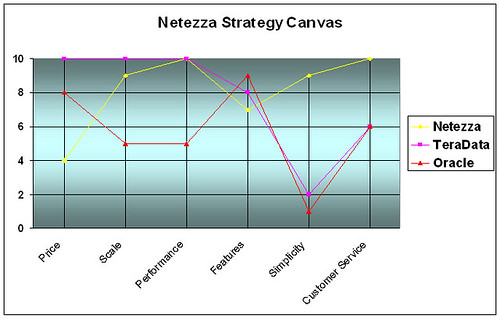
The following is what I consider to be a reasonably close strategy canvas for Netezza.
The following are my thoughts on value proposition factors and short descriptions as to why Netezza stands out.

Price - The price customers will pay for a roughly equivalent system: Netezza has developed a way to bring the scale and performance at a much lower cost making it much more feasible for companies that do analytical heavy lifting that used to require a much more expensive alternative.
Scale - Data volume that the system can handle: Netezza is still proving themselves in the area of very large data sets, however their systems are proving that they can scale to the likes of Teradata, and maintain performance
Performance - Query performance on unstructured questions/queries: In benchmarks Netezza has been shown to outperform all equivalent RDBMS vendors (sometimes by 10-100 times) and has even shown performance equivalent and wins over Teradata.
Features - The feature set included to build applications: Although Netezza probably doesn't have the complete feature set of its competitors, it has all the key features needed to build a highly functional data warehouse (eg - materialized views). They are specifically built for high performance data warehouses.
Simplicity - The number of FTE's and skill to set up, support, tune for performance etc: Netezza is called an appliance, because of a customers ability to plug it in and be up and running (well within a few days), as compared to a much longer time frame with competitors. Also, the system architecture and intelligence almost eliminate the need for tuning. Due to this appliance model this reduces the need for support FTE, and skills required, freeing up DBA's to do actual data analysis work instead of always needing to monkey with the engine.
Customer Service - The skill level and quality of customer support: Considered superior at Netezza. They do not hire low end customer support staff - rather, their customer support seems to consist of seasoned database resources with DBA and database developer knowledge. This may make for a more expensive CS team, but it is a small price to pay for reference-ability with existing customers.

Tuesday, October 10, 2006

Cheaper = Red Ocean Strategy

Seth Godin points to an angry note from a reader who was upset when she asked him to help persuade her bosses that the best way to grow their resort was to lower the prices, and he responded that she might better raise her prices and create a remarkable experience.

Seth's view from a marketing perspective: Cheaper is the last refuge of the person who is not a good marketer.

My view from a business strategy perspective: Cheaper, by itself, is admitting that you are competing in a commoditized market; Cheaper says that you are willing to accept smaller and smaller margins; Cheaper says that your customers only care about cost. Cheaper says that you want stay in a red ocean, and admitting that you have no vision to create a blue ocean strategy for your company.

Cheaper can be part of a disruptive business model and strategy if it is a component of an overall customer value proposition that is often combined with 'better' and 'faster'. If you find yourself thinking about the cheaper strategy, its time to re-invent your business or move on.