Process management, and ownership often comes natural to members of the IT department. Even though you will have people in IT that hate the idea of documented process, (often resulting from efforts to increase the quality of the output by creating more steps and details) they in the end still understand its importance. Software development methodologies are evidence that without effective and somewhat repeatable processes, IT groups would have trouble delivering new systems and managing existing operations.
On the other hand, business operational departments often do not embrace process management and ownership, but why? The efficiencies gained, and the ability to manage the process outputs are just as important, and often are the same or more complex than IT processes. I have been in organizations where business departments embraced process management and ownership, which is a great advantage when trying to empower the organization, however for others, the same is not true. Yes, this situation is often chalked up to ‘culture’, but if the IT department still embraces it, what is the difference?
In the book, Levers of Organizational Design by Robert Simons uses a framework called the Span of Attention to ensure that organizational design fits an organizations strategy and goals:
- Span of Control: What resources do I control to get my job done?
- Span of Accountability: What measures will be used to evaluate my performance
- Span of Influence: Who do I need to interact with and influence to achieve the goals for which I’m accountable for?
- Span of Support: How much support can I expect when I reach out to others for help?
The 'Spans' are in alignment when there is an X formed by connecting Control to Support, and Accountability to influence. Lets apply this framework to our process ownership issue.
The top diagram represents the Span of Attention for the process owner in the business group. Designated process owners in this hypo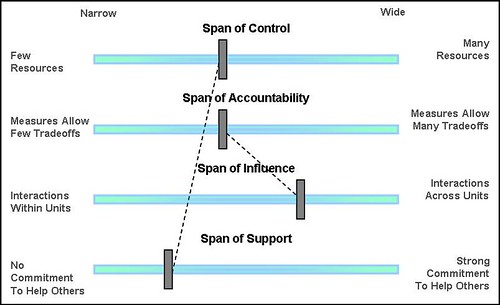 thetical organization are typically team leads/middle managers with moderate span of control. As process owners, they are not only accountable for successful execution of the processes they own, but the success of multiple interacting processes outside their span of control. Due to this interaction, there is high level of co-ordination across process domains as the work in progress moves between them indicating a wider span of Influence. Where things break down is in the span of support. The current org structure is highly silo’ed, and there is little incentive to understand or assist groups outside that which they are working in.
As you can see with the lower diagram which represents the IT Process Owner Span of Attention, the key difference is in the Span of Support. Even though the IT organization has a functional org structure, process owernship has much higher traction. One reason is the way that work is executed. Projects are created with members from different 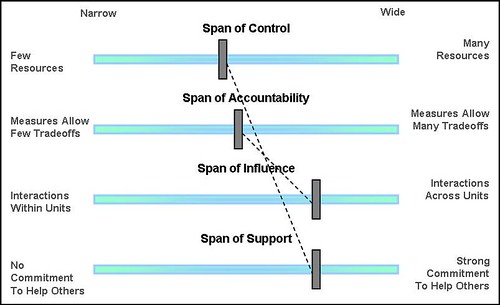 functional groups to execute end-to-end software development processes. The outcome of the project is more important than the outcome of a particular deliverable or component of work from a specific functional group (requirements, Project mgmt, development etc). This ‘levers’ the span of support to the right, bringing the spans into alignment and producing a successful environment for process owners to operate effectively. Other levers that aid in the success include sponsorship for process ownership/stewardship from IT leaders, cross functional work teams supporting continuous process improvement on methodologies, as well as an overall high level of knowledge around process concepts within members of the organization. Taking some of the basic concepts over into the business operations area would help shift the span of support to help individuals playing this role be more successful.
 I really like a good metaphor, especially ones where parallels can be drawn across many facets of the topic. The other day I found this post by David Armano that talks about the snacking type behaviour of people today with digital media. His post is an offshoot of an article in Wired called Manifesto for the new Age, however I like how he digs deeper into this idea of snacking discussing 3 aspects of snacking as it relates to consuming digital content:

