Showing posts with label process. Show all posts

Thursday, May 31, 2007

Hierarchies Don't Work As Well As They Used To

Hierarchies are tools that can used to categorize information into groups with logical 'parent-child' relationships. You see them everywhere, but the issue with them is that they are only one person's or one companies opinion of how the world looks. Companies use them extensively to describe their organizational structure, their process models, their product inventories, and this works great when everyone in the organization can be trained to fall into line and talk the same language.

However your customer doesn't always think in the same way as you. Their hierarchy may be different or most likely they don't think about a hiearchy at all! Second, not only are their new categories popping up all the time, but the lines are blurring between many categories. What once fell neatly into a well defined bucket, can produce hours of debate with no right answer.

The concept of folksonomies has become popular with the rise of Web 2.0. Folksonomies are user generated taxonomies or structured use to categorize content typically with the use of tags and tagging. Most people are familiar with tagging, but companies don't often see how this could or should be applied within an organization. However its not an all or northing decision. For example, it would be chaotic to organize your inventory internally through employee or customer created folksonomies (for the purpose of warehousing, ordering etc), but at the same time, why force your customers to try and figure our your archaic structure when they are trying to find a product to purchase? Yes search can help but customer driven folksonomies will help even more AND if tapped can also help search.

The thing is that most people in business today grew up in a world of parent child hierarchies. It has been ingrained in the way we think. Putting things into strict classifications helped us feel in control, but with the pace of change today, structures are quickly outdated and become very painful to re-organize. In our business we constantly fight with trying to classify advertising mediums, (ways in which you could advertise a product). It use to be simple - print, radio, television, direct mail and a few others captures almost everything. The fragmentation in this space is mind boggling now. How do you accurately categorize a blue tooth text messaging cell phone campaign? Or what about a direct mail campain via email. Is it an online offering or direct mail? Well its both but more importantly, it depends on who's doing the searching.

Even stretch your mind to think about internal classification structures. Since I have a background in process engineering, I know that people love to define and map out strict process hierarchies and 'teach' the rest of the organization how the business operates. But could processes be organized into employee created folksonomies to some degree? Process ownership and accountability is still required so its not about letting everyone decide separately how the organization runs itself, but the issue comes when people are trying to 'find' the details of a given process. (maybe for a new software application implementation) Do I find the 'employee onboarding process' under HR, under operations, under IT? (well it actually touches all three and more). Accountabilities aside, if tagging was was available and used, there would probably be a lot of time and argument saved by not having to create a hierarchy that meets everyones view of the world. And most importantly, the person who really needs the information, can find it.

The key point with this is to think about who your customers are (whether internal or external) and what they are trying to do with your information. The easier they can find, store and categorize in their terms, the more likely they will use your information assets in the future. How you categorize and use the data is completely different than how they see or want to use the data. Don't make it your customers problem to understand your structure.

Tuesday, December 19, 2006

Agile 'Pit Crew' Process

For all the big company focus on process improvements, it now seems that the term process is somewhat of a dirty word in small companies or startups who are focused on speed to market. Process, like everything, if it is overdone, it can be harmful and actually impede the very thing it was meant to improve. Too much and you become buried in trying to follow a set of steps, and checklists instead of accomplishing goals and fulfilling customer needs. Too little and you stagnate in chaos. Both lead to unhappy endings.

This got me thinking about the right amount of process in small company or start up (or perhaps any company for that matter). The analogy that came to mind was that of a formula 1 or Nascar pit crew. Pit crews have a series of tasks that must be carried out and others that are option depending on the condition of the car when it arrives. All have to be done quickly. Although it seems chaotic, there is process there, and great pit crews work like a finely tuned orchestra. Process is why the car doesn't get dropped without the wheel nuts on.

So even with a start up - some process is important. We have come to know this as Agile. Unfortunately some people thing that Agile is a throwback to to uncontrolled chaos before there was any process. Agile process at its best is finely tuned chaos that produces beautiful music. The key to fast process is to think not about documented steps and checklists, but about 3 things. The first two are frameworks and guidelines. The third and primary ingredient is skilled team members. Just like most of us would kill the process of a pit crew - so can ineffective members on any team. These 3 things supported by the right mindset, can allow process to become a powerful asset no matter how small (or big) you are if used appropriately.

Tuesday, October 24, 2006

Customer Value Stream Thinking

Michael Porter first came up with the concept of a value chain framework as a model to help analyze specific activities through which a firm can create value and competitive advantage. Value creation however is often vague ... value to whom, or from what perspective? In a world focused on customer value, we should be thinking about a customer focused value stream. But how do you do that?

1. Define your customer. With many companies today, the term customer is used very broadly. Robert Simon says in his book Levers of Organizational Design "By labeling everyone as a customer, the organization becomes confused about its purpose and whom it is designed to server". He states that organizations can be effectively designed to only serve one master. I like his definition of a primary customer as a group that routinely transacts with the company through open markets (and therefore has choice), and two, finds value in the firms outputs. Although other groups are important, having one primary customer allows the firm to make appropriate trade offs.

2. Now that you know who your primary customer is, think about the typical value chain where you have inbound logistics (inventory, receiving etc) at the beginning and Marketing, and Service at the end. Then, try flipping it around, where you may have your customer facing components at the beginning of your stream instead of at the end. This will help you think about your value stream in terms of a pull model (based on customer needs), instead of the traditional push model.

3. Think about your value stream components in terms of if, and how they deliver value to your customer. To do this, first use some LEAN principals to understand value-added processes - Suppose your customer had a complete view of all processes carried in your company... which ones would they be willing to pay for as part of the end product cost, and which actually contribute to the value (product or service) delivered. Next, think about an objective statement for each of the components. Often companies think about process objectives from an internal perspective, so try and shift your thinking to that of a customer. For example, lets take a typical value stream component such as 'marketing'. A traditional objective for this component might be "Sell products to our customers". Flipping the value stream in reverse as noted in #2, you might think of marketing as "Identify and Stimulate Demand". This is better, but still an internally focused objective. What might be a customer focused objective for marketing? Possibly something like "Effectively communicate offers (product & price) that are relevant and the appropriate to my needs".

This task can often be challenging. For instance, I once worked for a business unit in a large financial institution where we focused on offering unique products to customers for paying down bad debts. These customers would often rather not pay at all if given a choice, so trying to think about customer objectives on debt collection processes was an interesting exercises, but one that gave us a new perspective on the 'value' we were offering our primary customer. I might also point out that we were not only market leaders in the debt recovery space, but also had customers who were often happy about paying down their debt. I attribute this highly to customer focused thinking within the organization.

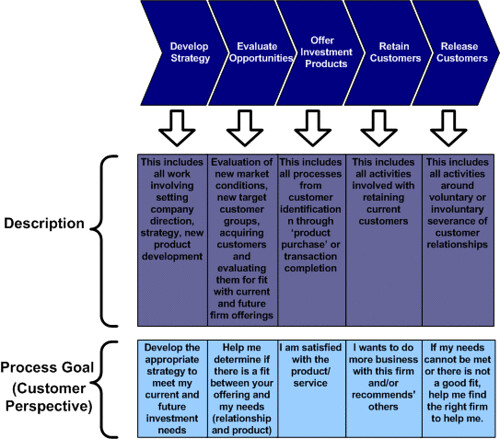
So let me present an example of what I have just talked about. I was doing some business strategy work for a friend who owns a small financial services business, and started to think about a potential value stream for him with customer focused objectives. To the right you see the sample value stream model I created. It is more than a one-time thought exercise. It can also help instill the right kind of thinking in your organization, and act as guidance when decisions are being made, and trade offs being evaluated as the organization carries out its business. Does what you do meet your customer objectives?