Showing posts with label startup. Show all posts

Sunday, July 22, 2007

Innovation at the Intersection

I have referred to the Medici Effect in a couple recent posts (here and here), and figured I should post a review/summary of the book. The term Medici comes from a banking family by that name in 15 century Florence Italy. This family and a few others began to sponsor creators from a vast array of fields, which caused people with wildly different skills to come to Florence. Their they found each other, learned from each other and broke down barriers between disciplines and cultures. Together they created a new world based on ideas generated, which became known as the Renaissance.

The author Frans Johansson, does an excellent job looking at intersection innovation and how it can be applied to todays innovators. For me the difference between a good book and a great book is how much it keeps me thinking after I put it down. This was one of those books. I kept a notebook with me as the concepts actually caused me to think about things differently generated new ideas on concepts I have been mulling around in my head.

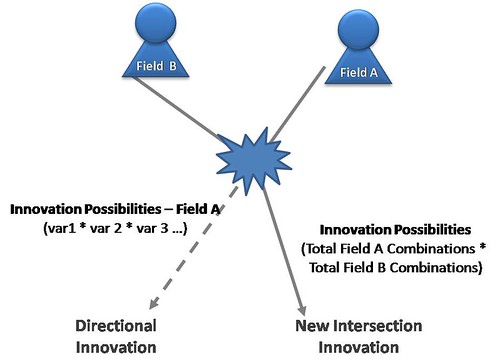
Everything is connected in one way or another. The trick is seeing how these things connect and how to use it. It actually goes against the grain suggesting specialization in a given field is not the best way to produced breakthrough innovation. Field specialization will produce directional innovation. In many fields directional innovation is drying up. All the relevant variables have been combined. We actually have a great chance of achieving ground breaking innovating by not specializing in just a single field of study/work.

If you have two different fields (A, B) and each field has a number of variables to play with your innovation potential in each field is

Innovation potential of A= x1*x2*x3*xn
Innovation potential of B= y1*y2*y3*yn

If you take two different fields of study and combine all the possible variables, your innovation potential has grown dramatically. You now have A*B possible combinations many of which have likely never even been thought about together.

Its not that you can just know a little about many fields - you still need to have some level of depth, but the key is applying concepts from one field to another, and then another etc. How do you do this? Well the book has many suggestions, but one simple way is to begin exposing yourself to different industries. Possibly take a job in a new field, or minimally just studying across different fields and begin to draw parallels with your current specialty areas.

Once change you will see on this blog going forward is that I will begin injecting books into my reading list that will hopefully expose me to other ways of thinking, learning and fields with which I have less knowledge, even though it will likely have nothing to do with my current job or expertise. My current reading list will start to contain titles that don't typically blend with my standard business titles.

In the meantime, if you are looking to find new ways of stretching your thinking, pick this book up and read it. I guarantee it will spawn some creative thinking.

Thursday, May 03, 2007

Going Into the Wind

A quote from Mark Cuban:

"If other people are coming to the same conclusion as I am, I think 'This is a business I shouldn't waste my time with'"

Maybe a little over the top, but something to think about. At the same time, don't ever be naive to think that you are the only one with your idea. There are other people with the same idea in their head right now. Its just a question of who has the desire and ability to get to market quickly with the right business model. (Notice I didn't say first to market).

Often, a little competition is good, and a sign of an emerging market. If you are the only one there, is there really a market? Industries with entrants are good. Ones with market leaders are bad. The great thing about the new economy is that ideas are now spawning not just new products and services but entirely new industries.

Going into the wind, and thinking on the edges is the place to start a great new business.

Wednesday, April 11, 2007

Stealth Disruptive Innovation

Clayton M. Christensen and Michael E. Raynor describes two types of innovation in their book "The innovators Solution": 'Sustaining Innovation' and 'Disruptive Innovation'.

Sustaining innovation is an innovation that brings to market a product or service that a company in the market could sell for higher margins to its best customers. In other words, sustaining innovation brings a better product into the market.

A disruptive innovation brings to market a product not as good as the products in the current market, and so it cannot be sold to the mainstream customers. But it is simple and it is more affordable. It takes root in an undemanding portion of the market, then improves from that simple beginning to intercept with the needs of customers in the mainstream later.


the authors contend that the odds overwhelmingly favor the incumbent leaders of the industry in battles of sustaining innovation, whereas the entrants have the upper hand for disruptive innovation.
(if you find this concept interesting, I recommend reading the book. You can also get a short overview in this interview with the author.)

As an entrepreneur this would naturally steer you towards creating disruptive innovations, because if you agree with the concepts in the book, you have a high likely of getting clobbered if you try and build a business with a sustaining innovation. The problem with focusing on disruptive innovations is that often entrepreneurs often miss the mark about what customers needed often due to a lack of knowledge of a particular business/industry or issues that customers face in that space. Obviously by having members of your team that have a background in that space will help (and it is unlikely you will get much credence/funding/support anyhow without industry knowledge on your team), but this still does not guarantee success.

However in some cases it might be possible to do both and this could be a very successful path. Going to market as sustaining innovation to build out the right feature set, and then ultimately turning to a disruptive model for growth. Takes whats happening in the housing market. Internet companies are creating all sorts of tools and services that are currently sustaining innovations for real-estate agents/companies. Solutions help agents post houses (information, pictures, movies), find houses faster and more efficiently for their clients, set up agreements between buyers and sellers etc. These solutions aren't perfect, however through usage the products are being refined, improved and integrated until ultimately a large majority of consumers will begin to wonder why they really need a real estate agent? (Early adopters already thing this) Now a sustaining innovation has become a disruptive innovation.

Often I think this happens somewhat by accident, but the creative entrant might be able to drive this path from the start, depending on the industry/space they are playing in. Industry, and more importantly how forward thinking the members of that industry are will impact greatly on the success of this strategy. If, however you can make it work, it will ensure an efficient focus of your resources on building/embedding the right product initially before shifting to a disruptive model for growth.

Sunday, January 14, 2007

Personal Shift

My blog has been quiet this past week - This is due to a career move that started monday. I have taken a position with a local startup Balihoo, and my mind has been swollen, and tired trying to weave myself into the team fabric as quickly as possible, leaving little time for me to put thoughts into the blog. The first week of a new job is always tough, but for me working with this small team where everyone from the CEO down is dedicated and driven and working together to make the company a success makes every day exciting. It is the most 'alive' I have felt at work in a very long time, and that is exactly why I will likely never move back into a large company environment. Timelines are in days or weeks, not months or years. You see the impact of what you are doing to improve company value quickly and clearly. Customer focus is everything - not something on a powerpoint slide, and passion as well as creativity are the rule, not the exception. I look forward to applying my learnings to future posts.

Tuesday, December 19, 2006

Agile 'Pit Crew' Process

For all the big company focus on process improvements, it now seems that the term process is somewhat of a dirty word in small companies or startups who are focused on speed to market. Process, like everything, if it is overdone, it can be harmful and actually impede the very thing it was meant to improve. Too much and you become buried in trying to follow a set of steps, and checklists instead of accomplishing goals and fulfilling customer needs. Too little and you stagnate in chaos. Both lead to unhappy endings.

This got me thinking about the right amount of process in small company or start up (or perhaps any company for that matter). The analogy that came to mind was that of a formula 1 or Nascar pit crew. Pit crews have a series of tasks that must be carried out and others that are option depending on the condition of the car when it arrives. All have to be done quickly. Although it seems chaotic, there is process there, and great pit crews work like a finely tuned orchestra. Process is why the car doesn't get dropped without the wheel nuts on.

So even with a start up - some process is important. We have come to know this as Agile. Unfortunately some people thing that Agile is a throwback to to uncontrolled chaos before there was any process. Agile process at its best is finely tuned chaos that produces beautiful music. The key to fast process is to think not about documented steps and checklists, but about 3 things. The first two are frameworks and guidelines. The third and primary ingredient is skilled team members. Just like most of us would kill the process of a pit crew - so can ineffective members on any team. These 3 things supported by the right mindset, can allow process to become a powerful asset no matter how small (or big) you are if used appropriately.

Tuesday, November 28, 2006

Startup mindset

The days of life time employment are over. 5 years even seems like a long time in our current business climate. I think that job security lulled employees into a space of monotony, boundary based decision making, and flat thinking. What would you rather have - life time employment, or life time learning. Finding both is just a myth now.

Don't dispair - a very inspirational post about the mindset of a startup(by Andy Monfried). As stated in previous posts - startup thinking is not just for startups.

Friday, October 27, 2006

Defensibilty and Web 2.0

Yesterday I participated in a Start-up Speed Dating event. In this case, it was about getting feedback on improving our pitch. If you are unfamiliar with the concept ours went like this - the start-up gives their pitch for 5 minutes and then the investor gave 5 minutes of feedback. The entrepreneur then moved to the next table, and we repeated this 10 times. Extremely intense but very exhilarating, and a great way to get feedback. Highly recommended for any entrepreneur. A common question that gets asked during this type of exercise is 'how defensible is your business', or 'what are the barriers to entry'. Patents tend to be what people focus on in this area, but as Guy Kawasaki points out in a recent blog post there are many different options on how to answer this question, relying on patents isn't necessarily the way to go.


Since my start-up falls into the Web 2.0 category, I found this post particularly interesting, as defensibility always comes up. Although I do like Guy's first response to such a question: “Defensible Web 2.0 company” is an oxymoron, I tend to use Guy's #9 option or a slight variation on it, with a little of #10. Additionally, we are trying to avoid falling into the patent diversion at least for the time being and focusing on building the product and finding a customer.

In the end Guy summarizes with the following communication goals as an outcome:
  • You’re street wise, so you know that you can’t depend on patents.
  • You understand that very few companies are truly defensible for reasons other than because they either achieved critical mass or had a nine-month head start.
  • You have domain expertise, connections, and what you’re doing is hard.
  • You’re not the only team that can do this, but you’re in a better position than most.
  • You believe that you can build a business better than anyone (a little cockiness is necessary for an entrepreneur to survive).

Tuesday, June 06, 2006

Thought Shift

Well, its been over a month since my last post, and I don't want to be another technorati statistic of bloggers who start and drop off after 3 months, so why not begin posting about my current thoughts. My thought focus has shifted to a business idea in the Web2.0 social software space, I have been hatching for the past few months, that is finally starting to get some traction to move me down the entrepreneurial path. Getting a startup going is hard work! ... To me, it is frustratingly slow wading through the entrepreneurial process quagmire. However in retrospect, it seems to be moving along at a decent pace.

So what did I do to start moving... After I had the idea somewhat fleshed out in my own head (enough so that I could describe it in oh 30... minutes or so:) I put together a concept deck and started going to peers to get their thoughts on if the idea was viable. Once I had talked over the idea with almost a dozen people, and had a number of shifts and refinements, I felt like it might be worth continuing. Plus, I now had my elevator speech down to about 10-15 minutes, so if I was in empire state building I might be able to tell someone about it. I then decided to move ahead and start drafting a business plan and recruit a team to help breath life into the concept.

This is the start of a very interesting journey (that hopefully keeps going) and its amazing all the things you learn, so after some coaxing from a colleague, I am going to start journaling some of these here. In the mean time, for other new entrepreneurs, here is a quick read no nonsense article that just came out around building a bulletproof startup. It would have been nice to have this a couple months ago, but in reading it, I felt better as my path seemed similar so far...