Showing posts with label business model. Show all posts

Sunday, July 22, 2007

Innovation at the Intersection

I have referred to the Medici Effect in a couple recent posts (here and here), and figured I should post a review/summary of the book. The term Medici comes from a banking family by that name in 15 century Florence Italy. This family and a few others began to sponsor creators from a vast array of fields, which caused people with wildly different skills to come to Florence. Their they found each other, learned from each other and broke down barriers between disciplines and cultures. Together they created a new world based on ideas generated, which became known as the Renaissance.

The author Frans Johansson, does an excellent job looking at intersection innovation and how it can be applied to todays innovators. For me the difference between a good book and a great book is how much it keeps me thinking after I put it down. This was one of those books. I kept a notebook with me as the concepts actually caused me to think about things differently generated new ideas on concepts I have been mulling around in my head.

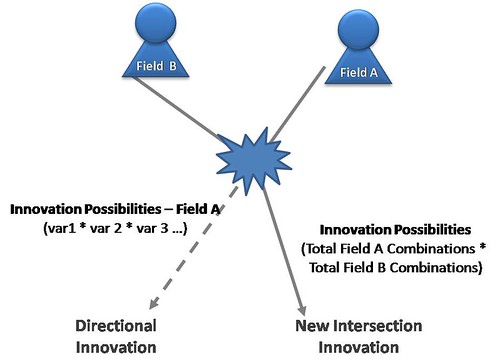
Everything is connected in one way or another. The trick is seeing how these things connect and how to use it. It actually goes against the grain suggesting specialization in a given field is not the best way to produced breakthrough innovation. Field specialization will produce directional innovation. In many fields directional innovation is drying up. All the relevant variables have been combined. We actually have a great chance of achieving ground breaking innovating by not specializing in just a single field of study/work.

If you have two different fields (A, B) and each field has a number of variables to play with your innovation potential in each field is

Innovation potential of A= x1*x2*x3*xn
Innovation potential of B= y1*y2*y3*yn

If you take two different fields of study and combine all the possible variables, your innovation potential has grown dramatically. You now have A*B possible combinations many of which have likely never even been thought about together.

Its not that you can just know a little about many fields - you still need to have some level of depth, but the key is applying concepts from one field to another, and then another etc. How do you do this? Well the book has many suggestions, but one simple way is to begin exposing yourself to different industries. Possibly take a job in a new field, or minimally just studying across different fields and begin to draw parallels with your current specialty areas.

Once change you will see on this blog going forward is that I will begin injecting books into my reading list that will hopefully expose me to other ways of thinking, learning and fields with which I have less knowledge, even though it will likely have nothing to do with my current job or expertise. My current reading list will start to contain titles that don't typically blend with my standard business titles.

In the meantime, if you are looking to find new ways of stretching your thinking, pick this book up and read it. I guarantee it will spawn some creative thinking.

Friday, July 06, 2007

Using 'Free' To Grow Your Business

There is a series of posts on techdirt (see list at the end of the linked article) that have culminated with a summary article about using the concept of free to grow your business.

The article raise two important points regarding the use of free in your business model. The first is that if done correctly, you can increase your market size greatly. The second is that if you don't, someone else will do it correctly, and your existing business model will be in serious trouble.

The author defines 4 steps that in theory can be applied to any market with respect to the economics of free. (The author admits that some markets might be more challenging than others)

  1. Redefine your market based on the benefits.
  2. Break the benefits down into scarce and infinite components.
  3. Set the infinite components free, syndicate them, make them easy to get - all to increase the value of the scarce components.
  4. Charge for the scarce components that are tied to the infinite components.
This sounds very straightforward, and I suggest you try it against your market or any market you have some familiarity with. I tried this with a few different markets and it was much more difficult than you might think. Probably the most difficult part for me was breaking down the benefits into infinite and scarce. In markets where the product is related to content, the concept of infinite is much easier to define.

For this post, I chose to try the post-secondary education market through this lens: (feel free to disagree or add on)
  1. Redefine the market: The benefit is innovation potential
  2. Break the benefits down: Infinite - course content, research results;Scarce - Field experts, facilities/equipment, thought diversity, idea diversity, degrees/certifications, talent pool
  3. Set the infinite components free: Make research results publicly available to companies and possible users of the research, (but track who is looking at it). Make all course information materials, book lists etc available online. Include sample or all video lectures. This supports the redefined market/benefits.
  4. Charge for the scarce components: Access to professors becomes more valuable, getting the certification and the schools reputation become more important, people who are serious about education will see higher value in that others who are there are serious about learning (while still allowing anyone with internet access to learn and see what the institution has to offer), getting the university to partner with a business to do R&D work (sponsorship).
Yes, I am sure you can shoot holes through the above idea or possibly have other ideas to make it better, but the point is to think about your business in a different light. The economics of free isn't just about giving away your product for free, but being smart about what can be given away and still be used to grow your business.

Tuesday, June 26, 2007

The Intersection of Business and Technology

At the intersection of business and technology, people often get very excited or tense, optimistic or worried, challenged (in a good way) or frustrated. Frans Johansson in The Medici Effect talks about intersection innovation - a place where two fields collide and divert along a new innovative path. The collision between business and technology has been a slow moving one over a very long period of time, but companies, are starting to realize, what many or most entrepreneurs already know - the endless number of new paths that can be taken when you start looking at these two areas together instead of separately. We are now at a point where one field can rarely exist for any length of time without the other.

John Hagel has now joined Deloitte & Touche USA LLP and will be heading up a new research center to focus on the business issues created at this intersection.

He poses a number of intriguing questions around this topic of business/technology interesection here with some thought provoking commentary that is worth a look by any reader interested in the topic of this blog.

Foundational

  • What if there is no equilibrium?
  • Can the firm survive as the action flows to the edges?
  • Are all ecosystems created equal?
  • If the world is so flat, why are spikes becoming more prominent?
Strategy
  • Is adaptation all there is?
  • Can we escape the Red Queen effect?
  • As “L curves” replace “Bell curves”, what are the most promising routes to the head?
  • We have a growing realization that stocks of knowledge are diminishing in value relative to flows of knowledge, but what is required for effective participation in the highest value flows of knowledge?
  • What are the opportunities for the bottom of the pyramid to attack the top?
  • How do we measure success when so many of the rules are changing?
Technology
  • When is self-organizing not enough?
  • How are pull platforms likely to evolve?
  • What is the next generation of IT architecture?
Being at this intersection is to me what makes these two fields interesting and exciting for some while scary and daunting to others. It is the combined knowledge of these two areas that is driving much of the disruptive innovation we see today in the new economy. Knowledge and innovating down one side without considering the other will not produced viable results that will be able to compete in the current and future marketplace.

Tuesday, May 29, 2007

Ideas for the Newspaper Industry

A while ago, I posted about re-thinking the newspaper industry. Here are a couple of ideas I had around innovating in that space. I by no means have any background in this industry, but here goes. In my language customer is defined as a person who gathers utility from reading the contents of a newspaper.

Product Innovation: Allow readers to customize their content. This is not a new concept online. Personalized home pages, email alerts, RSS are all commonplace across the web, and if not already should be integrated into the online channel for the newspaper. This will not only help you better understand what your readers are interested, and allow for better targeted advertising, but will also make them better able to navigate the reams of content available.

Second, in the same vein - appreciate the fact that many of your users don't have an interest in online reading, however that doesn't mean that you should be able to provide them tailored content. Printing innovation is evolving rapidly. Why not allow a subscriber to tell you what they are interested in and have a customer newspaper printed for them based on these interests? Then urge them to go online and rate the content that was delivered so that future papers can further be tailored to their interests. (similar to what some companies are doing to tailor music streaming)

Beyond that I see digital newsstands that would allow a user to select from a menu, and have a custom paper printed off immediately on authentic newsprint (like a soda machine that spits out a newspaper). Plus advertising and print layout would be defined on the fly by software. Further - give people a plastic 'remember me' card, so that they can use with other electronic newsstands, of which get updated every time they make a change (similar to an ATM). Once this is attained - next step is partnering with other news organizations to share/combine content. (Give me the wall street journal combined with Boise local business in one paper!)

Business Model Innovation: Why not create a model where the price of the paper to the end customer varies based on how much advertising they are willing to accept. The more ads, the cheaper the paper becomes. It has been shown that people are willing to pay for advertising free niche content. Think pay-per-view or Sirius. This could initially be packages with varying levels of advertising along with various skews towards types of content (local, sports, business, etc) The content selection would then of course help associate related advertising.

Next combine the two ideas. Allow for infinite tailoring of content to what users need combined with business models that allow pricing to vary by customers interest or lack thereof for advertising, and have any advertising sent be targeted. Meet the long tail needs of your readership.

These may seem unrealistic (or maybe not), but in the end its about thinking on the edges. Most of what I talk about here requires technology and online interactions with consumers, but it doesn't rely solely on the online medium for content delivery.

Now when we get to a point where e-paper is almost as flexible as real paper (we are not that far off), that opens up entirely new opportunities.

Wednesday, May 16, 2007

Rethinking The Newspaper Industry

Yesterday, I was at a conference on the impacts of new media on marketing for the Capital City Communicators. One of the panel discussions centered around the changing interactions between marketers and journalists. What I found most profound after listening to the panel which included players from both sides - it was yet another example of how baffled, and stubborn most newspaper organizations are regarding the changes in the industry. These changes are rocking the foundation of a business model that is well over 100 years old. They simply have no clue on how to turn things around, so here are 10 thoughts I had after chewing on this issue for a day. I am not a journalist (at least in the mind of a journalist) but maybe that’s a good thing! Its always easier to think on the edges, when you are not trying to defend the status quo.

  1. The internet (and other new media) is not just another channel to pipe the exact same print content. Newspaper organizations need to take full advantage of the this channel's ability to provide richer interaction to provide the customer a unique experience will make it valuable and something that can either supplement or provide an alternative to traditional print media.
  2. Traditional print was a time of scarcity (of space). Now, scarcity is no longer an issue. With new media you have the ability to make anything available – not just what you think is important. The New York Times tag line has always been ‘All the news that’s fit to print’. Remove this elitist mentality from your thinking.
  3. Print is no longer effective for breaking news. It’s a time-to-market issue.
  4. Satisfy the long tail of news readers. Editors shouldn’t be choosing the content – they need to figure out ways for their customers to help them, and better yet – figure out ways to create unique content for all users.
  5. Use your online channel to better understand customer needs.
  6. Every piece of news is news to someone.
  7. People will pay for things that they see value in. If given the exact same content across two channels, but one was free, would you pay?
  8. Journalists should stop thinking of themselves as only news breakers or news creators. I believe the future is in aggregation. Aggregation of information, diverse opinions, providing local perspectives etc.
  9. Don’t just think about readers as customers in your business model – think of them as potential suppliers. Think about the full business ecosystem of a newspaper organization in the new economy.
  10. You can only have one primary customer. Think hard about who it is, and who it should be in the new economy. Readers? Advertiser? What business models will work based on this perspective?
All well and good to provide this type of commentary as an outsider right, but in a future post I will describe a couple of business ideas I came up with that might help bring a traditional newspaper business over the hump.

Thursday, May 03, 2007

Going Into the Wind

A quote from Mark Cuban:

"If other people are coming to the same conclusion as I am, I think 'This is a business I shouldn't waste my time with'"

Maybe a little over the top, but something to think about. At the same time, don't ever be naive to think that you are the only one with your idea. There are other people with the same idea in their head right now. Its just a question of who has the desire and ability to get to market quickly with the right business model. (Notice I didn't say first to market).

Often, a little competition is good, and a sign of an emerging market. If you are the only one there, is there really a market? Industries with entrants are good. Ones with market leaders are bad. The great thing about the new economy is that ideas are now spawning not just new products and services but entirely new industries.

Going into the wind, and thinking on the edges is the place to start a great new business.

Friday, April 27, 2007

Innovation Should Be Elegant

The Elegant Solution is what Mathew May says companies should be after when they innovate based on his work over a 10 year period with Toyota. Simple is better. Elegant is best. There is an excellent executive summary of this book on ‘Change This’, if you want to get the key concepts, but I have summarized some of the items I felt where most influential. Also having worked at Toyota myself, I can attest to the forward thinking nature of this amazing company.

According to May, the elegant solution is one in which the optimal outcome is achieved with minimal expenditure of effort and expense. It is about value, not gadgetry, and it is about not losing site of the why behind the what.

Some other key thoughts to consider about elegant solutions:

  • People don’t want products and services. They want solutions to problems.
  • Elegant solutions embrace an overarching philosophy of doing far more with much less
  • An elegant solution is recognized by its juxtaposition of simplicity and power.
Toyota has 3 primary principals of innovation that drive toward elegant solutions:

Ingenuity in craft: Ingenuity means free thinker. Companies don’t innovate, people do. How have you changed the way you work in the past week?
Pursuit of Perfection: The pursuit of perfection is not focused on achieving perfection, its focused on chasing it. Imperfection drives innovation.
Fit with Society: “Great innovation is great in large part because of context. Context separates invention from innovation. Context is like the frame in art. If the canvas doesn’t fit the frame, the whole thing doesn’t quite work well."

10 Ways identified to put these principals into practice

  1. Let Learning Lead: To what degree is experimentation built into your core work processes?
  2. Learn to See: How well do you understand the problems your customers face?
  3. Design for today: Focus on clear and present needs. If your idea became a reality today, how well would it do?
  4. Think in pictures: What opportunities exist to use images and visual references?
  5. Capture the intangible: How do you connect emotionally with your customers?
  6. Leverage the limits: Innovation demands exploiting limits. Which goals will stimulate new thinking?
  7. Master the Tension: How can you generate creative tension?
  8. Run the Numbers: What patterns can be investigated to challenge convention?
  9. Make Kaisen Mandatory: Continuous improvement always. How do you sustain a steady flow of ideas?
  10. Keep it Lean: Complexity destroys value. What elements of complexity would you customers love for you to remove?

If you find this interesting, I encourage you to read the manifesto and or buy the book to look for applications in your organization.

Wednesday, April 25, 2007

Innovation and the Pace of Change

The term futurist sometimes seems strange to me with the ever increasing pace of change. the future used to be about decades into the future, and now it may only be months or years. Futurist, Jim Carroll's often has thoughts on the future of future of business. He has recently listed 10 truths about the future of business, however given the pace of change, these are actually trends that you need to consider now!

(I have trimmed down some of Jim's commentary and added a bit of my own.)

  • It’s incredibly fast: Product life cycles are collapsing, and comoditization happens faster than ever.
  • It involves a huge adaptability gap: Change management will cease to be an topic for projects or workshops, but a constant reality.
  • It has a huge instantaneity: The average consumer scans 12 feet of shelf space per second. Most news becomes old hat within 36 hours of emerging. We live in the era of the rapid idea-cycle.
  • It hits you most when you don’t expect it: Every organization must deal with two realities: the rapid emergence of new technologies, the sudden adoption of old-hat ideas.
  • It's being defined by renegades: Industry expatriates are redefining and innovating through their own startups. See my post on thrill seekers.
  • It involves partnership: Think 'business ecosystems' - not just 'my' business.
  • It involves intensity: Running your business at video-game intensity. (Thanks Jim for the great metaphor!)
  • It’s bigger than you think: Don't just think inside the boundaries of your industry - be prepared for competition from companies that you had never thought would be in that space.
  • It involves innovation intensity: With rapid change, everyone in an organization must innovate. Innovation is no longer a responsibility for the few.
  • It comes from experiential capital: Learn and relearn. Corporate equity isn't just money: it's the cumulative experience and knowledge of the team.
After reading these, do not dwell on how they will impact your current business. It is much more prudent to simply being thinking about how and when you will shift your business model, strategy and processes to handle these. Turn them into opportunities instead of threats.

Thursday, April 05, 2007

When Information is Endless...

A thought I had...

Advertising has much higher influence when there is no other way to gather information about a product or service. Finding information is no longer an issue in todays hyper-connected world, so where does that leave advertising?

Monday, April 02, 2007

Service Innovation?

Business week has put out an article on concept being called Service Innovation. The general concept of service innovation isn't new, but now that there is a consortium of top tech companies (IBM, Cisco, Oracle etc) creating what will be know as the Service Research and Innovation Initiative. Jim Spohrer, the director of Service Research at IBM uses a classic example to describe this hidden and not widely recognized term:

"The average person knows the story of Thomas Edison, the inventor and innovator who came up with the light bulb. People don't tend to think of the related service innovations—getting light bulbs into houses and schools, setting prices for the electricity services to keep them lit. That's all service innovation."

Most people equate innovation with production innovation. There are in fact several categories, or ways to classify innovation, however, to me the concept of service innovation seems like just a specific type or slice of business model innovation. I read through the article and found more information about the consortium but not a lot on the title concept of the article, so I thought I would put some thought into it.

First reset your thinking on the concept of a business model. There are many definitions, and miss-uses for the term but the best description I have found is from Alex Osterwalder at Arvetica. There is also a great diagram. In short Alex defines a business model as:

A business model is a conceptual tool that contains a set of elements and their relationships and allows expressing the business logic of a specific firm. It is a description of the value a company offers to one or several segments of customers and of the architecture of the firm and its network of partners for creating, marketing, and delivering this value and relationship capital, to generate profitable and sustainable revenue streams.

Next, you need to understand what business model innovation is. Here is a nice short description of business model innovation from Business Innovation website.

In some cases the innovation rests not in the technology or product or service, but in the business model itself. Business model is a broad-stroke picture of how an innovative concept will create economic value for the ultimate user, for the firm and its shareholders and partners. It considers the infrastructure required to move the product/service to the market in a manner that it both easy and convenient for customers and profitable for the firm.

If you want to understand more about business model innovation, here are a couple more excellent (free) resources: Global CEO Study from IBM, Permanent Innovation e-book by Langdon Morris at Innovation Labs.

Where business model innovation focuses on many aspects across the entire value stream service innovation seems to focus in not only on specific components of the business model focused on delivering value to the companies customer. So is it yet another new concept - likely not, but is it important in the new economy? Definitely!

After thinking about how they (vaguely) described service innovation, I tried to think about experiences I have had in this space and came up with one while working at Toyota Financial Service.

For a period of time a few years back, I was part of a representative team in the early stages of what I would call a competitive consortium service innovation initiative. The official name for the initiative was/is Route One. It was a partnership agreement between financing arms of the top 4 auto manufacturers in North America. (GMAC, Ford Financial, Chrysler Financial and Toyota Financial Services). Think about this for a moment and you will understand the magnitude and difficulties with something like this. The goal was to create a single interface for auto dealerships to finance with not only the big 4 but with any other Financing agency that wanted to join. The dealer could send financing applications out to any participating members through a single interface. The system was to also interface with their internal/in-house dealer management systems, and also help manage the application all the way through contract once a financier was selected.

A great win for dealers but also for participating members. The founders of course split the cost of building the app. (much less than if they tried to build some or all of the components themselves), and would actually receive revenues from the application at a point when the initiative was revenue generating. All participating members would gain from having potential access to new financing deals, and financiers would be forced to compete based of service and finance offerings rather than forcing the dealers to choose upfront. Ultimately it would mean a better deal for the end customer.

To me this felt like a great example of service (and business model) innovation. I always find working through my own examples helps me evolve my thinking on a specific topic. I would be interested in hearing other examples of how readers felt they were involved with service innovation.

Saturday, February 10, 2007

The Franchise Model Is Not The Only Model For Growth

I am currently about half way through The E Myth Revisited by Micheal Gerber. The book published in 1995 is considered a classic read for the entrepreneur, and while I have found many concepts in the book to be right on, I feel that others are showing their age and/or don't work as well in the new economy.

One of these items is his concept of the turn key revolution, and franchise model to grow your small business. In the (only) presented model the goal of course is to design repeatable processes and procedures for the lowest common denominator. Yes, this has worked well for companies like MacDonald's, but these concepts do not apply as well for business in the new economy. Yes, if you are trying to create and grow yet another fast food business, grow a carpet installation business or other manual labor based business this book will provide you some decent guidance, but unfortunately the running dialog with a woman who is trying to grow a pie baking business just doesn't ring home to me and likely any other entrepreneurs building thought/knowledge-based businesses.

Profitability does not have to mean growth in numbers, and being forced to build a business that can be executed by the lowest common denominator. Remember that small is the new big in the new economy and business model innovation is what is propelling the next wave of profitable companies. Think about ways you can grow without having to create a huge unskilled labor force following procedure manuals. You don't have to look at technology companies - think about successful companies such as Southwest Airlines. Yes, there are procedures, but the employees are taught to be entrepreneurial, and solve problems on the front lines that satisfy and create value for their customers. Even in our startup we selectively implement process and procedures in certain cases as we grow and depending on the skill of the people doing the work, but the goal is not to build a turn key/franchise. It is to create efficiencies and build business value with the smallest team possible - not create a monotone business model that can be 'stamped'.

Seth Godin blogs about a concept he calls sheepwalking. I think of it as the lemming effect. If you hire people to just follow the procedures thats all you get. If that is all it takes for your business to be successful, great, but in the new economy I would like to find a company starting up that will be successful with this model. Compliance doesn't alway create exceptional customer server and definitely does not create new innovative business value for your company. Gerber states that the franchise model is how you as a small business owner/entrepreneur get away from having to do the work yourself, but in times when innovation is what is driving successful companies and you have built a shop or franchises full of lemmings, ultimately you are still stuck in the driver seat forced to be the one that helps the business grow. No you aren't doing the physical work, but if everyone is taught to follow the manual, who is left to innovate to take the business to the next level?

Growth doesn't have to always come from adding bodies, and building to the lowest common denominator so you can expand a business of flat thinkers that follow the status quo. Look for rhythmic thinkers. Those that eb and flow with the melody of business. Those that don't get frazzled with a sudden change in tone or pitch, and quickly adjust if they fall out of key. Those that can beat to your drum, but also know how to adjust when the song changes.

Monday, January 22, 2007

Understandable & Effective Business Strategy

Business strategy is often one of those things talked about in an executive office, but often not taken out to the organization (large or small). Whether it is so complex that only executives can understand it or the perception that is too complex to communicate by those developing it varies, however strategy works best when everyone is aware of it and understands it. Not everyone can or should participate in developing it, but execution works best when everyone is driving towards the strategic goal.

Even the term strategy congers up advanced diagrams, and complex thinking, that scares many in a company to leave it to the leaders in the organization. This is also wrong. Business strategy doesn't have to be complex.

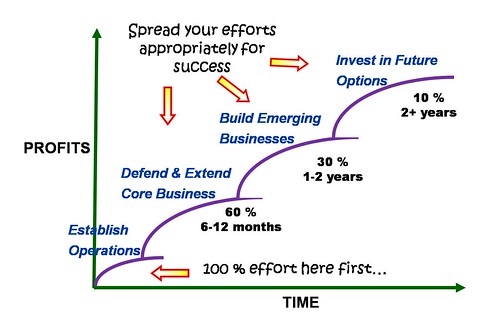
Here is a simple model that can be used to communicate strategy to the organization that is simple but effective for both large and small organizations. Startups especially, can use this to help the team think about something beyond the current month or what will happen after the beta release. If you become a market leader in a new space, you still need to be thinking about the day when your differentiation will be copied or 'commoditized'.


The model works on the simple principal of always thinking ahead. Of course if you are a startup, you initially need to be focused on getting something to market. This required focus and some thinking about market segment targeting. However once you have went to market, there are 3 key curves in which you should be thinking about.

Defend and Extend: This is the hear and now. Many companies spend their entire effort in this curve, only to be surprised by the competition, and forced into a commodity market, which is a losing battle. Spend 60 % of your effort in this curve at any given time. This is your sweet spot and where the business makes the majority of its money. For most companies in the current competitive environment, you should assume this will be a 6-12 month window.

Build Emerging Businesses: Emerging business's are in the 1-2 year time horizon. This is the next big offering that will keep your business on top, once your current cash cow is a commodity. You should be spending about 30% of your efforts in this space, so that when the time is right, these offerings will become your core business.

Invest in Future Options: Future options are in the 2+ year horizon. This is your companies R&D. It is especially important for services businesses, as it is often forgotten. You want about 10% of your effort in this space right now. If you are a startup, this could be as simple as getting the team together for drinks after work and coming up with a few ideas on where your product could get to. The key point is to be thinking about it. As your emerging business becomes your core, so to does your best R&D item become your next emerging business option, and so the cycle continues.

I have found that this is a simple and effective strategy model that can work in large organizations down to a bootstrapping startup. It is a simple effective visual that gets people thinking the right way about sustaining your business, and can be easily communicated.

Monday, January 01, 2007

Blockbuster Using Its Assets For Innovation

Watching my home team Boise State play in the Fiesta Bowl tonight, I noticed the sponsorship by Blockbuster and its new offering Total Access Service which is competing against the current leader in mail order movies - Netflix. Blockbuster has had a similar offering to Netflix since 2005, but although they could replicate the basic model, their service and efficiency wasn’t as good as Netflix, and the results were less than stellar. Some companies would just regress back to their legacy model, but Blockbuster evolved its Total Access Service into a new business model innovation.

They replicate the model of Netflix, but then they add an additional service that takes advantage of their existing brick and mortar assets. Not only can you mail your movies back once you finished, you can bring them back to store, and pick up new movies from their as well. Instead of trying to compete with their existing legacy movie delivery model alone, or trying distance themselves from the model that built the company and move to compete on the same service as Netflix they combine aspects of both models to offer business value that cannot be replicated by Netflix.

Many such as Tech Crunch blogger Michael Arrington are deciding that Total Access is a much better option and are switching. They use a great play from the startup playbook on this current add campaign. They compare their sevice directly to a known player (Netflix) in the commercial, and then explain how their offering is better. This is compelling for Netflix users, as well as current blockbuster customers who are thinking about using a mail order movie service.

In an era where many traditional business are being impacted by digitization and internet business models, its great to see examples of companies using current expertise coupled with creative thinking to create competitive advantage. Their next challenge is when broadband infrastructure becomes robust enough to deliver movies purely in digital format.

Tuesday, September 12, 2006

Framing The Ambiguous

I love frameworks.... Learning new ones, applying them, and creating ones in ambiguous territory. Frameworks are part of the toolkit that allows me to jump off a cliff, and make up the water on the way down, when taking on new challenges.

Frameworks help take concepts that appear cloudy and make them clear. I remember early in my consulting career having some colleagues that worked on organizational change management. I remember thinking that must have been a 'fuzzy' job, comforting employees through a change, but a couple years ago, I decided to expand my knowledge base in this area, and got certified with Prosci on their change management methodology. Wow! - a framework for helping people adjust to change! And it worked - it helped get a handle on what needed to be done and how to make it efficient. What makes frameworks great is that they aren't a recipe on how to do something (which is why some people don't like them), but it gives you a point of reference and then allows you to adjust for your needs and fill in the details.

I have started looking for modern frameworks around organizational design, business models and business strategy, in a knowledge based economy which are often hard to find, since it is a shift from traditional thinking on business strategy.

I have came across a great framework or ontology for business modeling recently by Alex Osterwalder, who has a consulting company called Business Model Design. I have found that the term 'business model' is often a loaded, and over-used term. People use it for many different things. Alex has a great summary of what a business model is and a framework for analyzing and creating business models. There is also an excellent case study of applying the framework to analyzing the Skype business model. His site also links to some interesting business modeling tools, which I am currently experimenting with.

With the technology startup I am working on, this discovery has came at the right time. I have been looking for a mechanism to describe our business model via a simple framework. As with many technology startups, the business model is often hard to describe to potential investors since they are operating in a non traditional space. (It would be much easier if we were selling running shoes.) I am attempting to utilize this model to not only clarify our model but also use it to compare against our competition and potentially complimentary models.