Showing posts with label start-up. Show all posts

Sunday, July 08, 2007

Failure and Innovation

Failure in most companies is a bad word. Some more innovative companies have leaned that failure is part of innovation, but most of what people hear is fail quickly or don't repeat the same mistake which are both good things to keep in mind, but not the whole story. Entrepreneurs are acutely aware of the concept of failure, and it is often equivalent to a badge of honor in the startup community. What else should an innovator (company or person) keep in mind with respect to failures?

Frans Johansson in the Medici Effect says that mistakes and false starts are part of the process for making ideas happen in unknown spaces, and must be factored into the equation in three ways:

Try ideas that fail to find ideas that won't
So how do you create that type of environment?

  • Its not just enough to be accepting of failure, but output whether generating success or failure should be rewarded.
  • Failure to execute ideas is the greatest failure, and be punished
  • Be suspicious of low failure rates. Maybe not enough risk is being taken or people are hiding mistakes
  • Hire people who have made intelligent failures, and let others know about it
Reserve resources for trial and error
One thing to note about innovations in new directions are that many assumptions you make during development of the idea will be wrong. This is the primary reason why many internet startup companies in the late 90's failed. They thought they were going to get it right the first time. You need to keep an agile mindset in your team and company.
  • Be prepared to change your plan of execution
  • Give yourself the time for several attempts
  • Spend your money carefully and try and keep reserves for more than one try
  • Be extremely careful if your reputation or goodwill is riding on success the first try
Remain motivated
Probably the most important, but you must find ways to keep motivation high. Essentially you need to build passion in your business.
  • If intrinsic motivation is high, and we are passionate about what we are doing, creativity will be free flowing
  • People who are driven to perform do so based on internal drive - not external incentives. They want to do a good job.
  • People in new innovation spaces must believe that they will get the reward they deserve for their efforts, even though at the start no one really knows what the reward will be.
Clearly it is important in new innovation spaces that failure is expected, but if you are in this space, make sure it goes deeper than that. It must be supported with the appropriate culture and incentives, allong with appropriate expectations, planning, resources to have many 'do-overs' in order to find the right solution.

Monday, July 02, 2007

The Internet Technology Dip


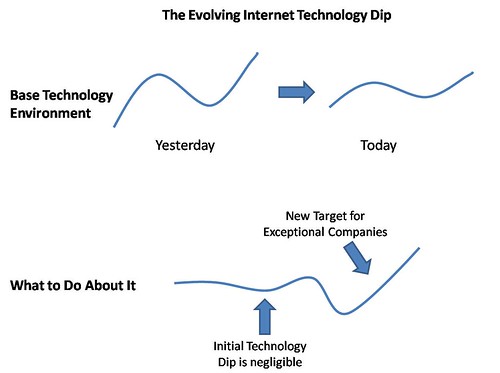
I just finished listening to The Dip by Seth Godin. A short and too-the-point read. It got me thinking about the technology dip that occurs with internet startups. This dip used to be very deep, and difficult to push through.

Tools and hardware were expensive, proprietary, and had very low interoperability. You had to have people with very speicalized skills in house to operate it. Now, tools have become democratized, they are cheap or free with the open source movement, there are many available API's and expertise can be found easily often in the form of online communities. Also, you can typically procure enough hardware to with a very low budget to get any project to market. The technology dip has been flattened.

This shows up of course in the market, with the explosion of startups that have anywhere from a small technical component to those focused solely on technology. Now basically anyone with half an idea and access to basic development skills (even self taught) can attempt to enter the market with an internet based product. The dip has been drastically flattened and easily passable producing many half-baked and me-too products. The barrier to quitting at least on the technology front has been drastically reduced.

As an internet startup, if you are planning on using technology to differentiate, you need to understand this change. If you want to be exceptional, you have to move to the next technology dip or dig new deeper technology dips to rise above the crowd. No longer can you throw together a basic e-commerce sight, social networking site, bookmarking tool, or video sharing site and call yourself an exceptional, stand out from the crowd business. Any good VC/angel will see through this as well.

Basic web apps become commodities extremely fast. You need to take your technology to the next level of intelligence creating or entering the next generation dip that your average weekend web programmer will not be able to climb out of forcing them to quit. You need to take existing tools and combine/evolve them into truly value added products that support a need that people are willing to pay for. How can you make your application smarter than every other offering out there? How can you create new innovation by combining business needs with technology?

Wednesday, May 23, 2007

Act with Purpose

Have you ever found yourself so busy that you fail to see the forest for the trees? That is, you are so busy doing 'tasks' that you forget why you are doing them? I think this can happen the best of people in any organization large or small. Due to constraints (financial, resource etc) small companies are less likely to do this or at least do it for long before they find themselves out of business, but I believe it is something that you need to remind yourself about every day. I found a quote the other day over at Found+Read that sums this up very well:


Don’t confuse activity for progress.
Time is precious. Act with purpose.

Its not enough to throw this out in a staff meeting, up as a quote on the wall or even as part of your company values unless you also live it every day. Remind yourself regularly, make it a part of what you do, and also part of how you speak. It will then spread to others and become rooted in your culture.

Many times, I believe that large companies could become less bloated, more efficient and effective if they could just embed this simple philosophy, not just as a statement inside their company walls, but as a strand into their cultural fiber.

(By the way a little plug for an item in my blogroll - Found+Read is a fairly new entrepreneurial blog that is a great resource for anything who falls in this category or wants to fall into this category. The other think I like about it, is that it is a blog with some social networking aspects build it - to me this model makes it more 'sticky' than other blogs in your feed list)

Wednesday, May 02, 2007

Continuing Evolution of Web 2.0

In some respects the web 2.0 surge has been an amazing open market innovation incubator. It has allowed the market to innovate off in any direction and produce some very interesting products through easy access to open source tools and data offered up freely by large platform vendors through API's. Unfortunately, startups in this space are usually 'cool tools' pretending to be businesses with a revenue model that likely has little depth beyond advertising with Google ad-words.

John Hagel suggests that Web 2.0 is currently going through an evolution, and points out some important considerations for both the entrepreneurs as well as the the platform companies that are supporting these. For startups the days of having no ambition to build sustaining business models beyond a strategy of feeding off of others in hopes for a high priced buy out are quickly coming to an end.

John says that entrepreneurs in this space need to understand these shifts to combat the change in the environment:

First, you can accelerate the innovation in the services you offer so that you are constantly one or two (or more) steps ahead of those tempted to copy you. Second, you can find ways to use your service offerings to build trust-based relationships with your users, ideally with some powerful network effects that will make it very difficult for later entrants to pry these people away from your service. Ideally, these two approaches can be integrated by motivating your users to enhance your services themselves so that the more users you have the better your services become – the essence of Web 2.0.

In addition I feel its important to think about how the plethora of features can be combined, tweaked and used for real business application. Think enterprise 2.0. If there is a business application, there is revenue. Take wikis. They quickly evolved into a feasible tool across many business applications, and although you can still get them for free, there is revenue potential in not only the product but service and support. Even Twitter is in the early stages of evolving into a potential business tool.

In many cases the biggest barrier is not finding a use for these tools in business, but changing the perception of value within organizations. Consumers are more open to change and great proving grounds for concepts that can then be applied in business. The consumer landscape allows you to build and test a network before carrying it into the business world. It is interesting that business software used to drive consumer software, and now it is often the other direction.

Friday, March 16, 2007

Thrill Seekers & Company Culture

Seth Godin writes that there are basically two types of employees.

1. Thrill Seekers love growth. They most enjoy a day where they try something that was difficult, or--even better--said to be impossible, and then pull it off.
2. Fear avoiders hate change. They want the world to stay just the way it is. They're happy being mediocre, because being mediocre means less threat/fear/change.


Of course there is a lot of variation in people along a spectrum from one side to the other, however it is the people on the thrill seeking side of the fence that will prosper in the new economy.

So why should Companies think about this?
> Thrill seekers will naturally migrate to smaller companies and startups. Small companies and startups are a natural fit for this type of individual. They often start in, or try large companies, but thrill seekers cannot be happy for long in most large companies today because the company culture is predominantly Fear avoidance. They will get frustrated and leave.
> Thrill seekers will avoid places where unions and/or union mentality exist. Unions and union mentality shops are a breeding ground for fear avoidance.
> Thrill seekers attract each other. Whether purposefully or unknowingly, they seek out individual within their company or colleagues that feed their fire. In an era of online communities this becomes even easier.

What can companies do?:
> Understand where your employees fall on the spectrum and seek to help thrill seekers feed their needs, and funnel their energy to growing the company.
> Create a startup culture in your team, division or company, that will help move people to the thrill seeker side of the fence. Some will move faster than others, but the key is that you actively engaging with them.
> Build opportunities for thrill seekers across your company to meet, and use their creative forces to help drive change in your organization through cross functional teams, that allow them to drive the discussion.

What do you think?

Monday, January 22, 2007

Understandable & Effective Business Strategy

Business strategy is often one of those things talked about in an executive office, but often not taken out to the organization (large or small). Whether it is so complex that only executives can understand it or the perception that is too complex to communicate by those developing it varies, however strategy works best when everyone is aware of it and understands it. Not everyone can or should participate in developing it, but execution works best when everyone is driving towards the strategic goal.

Even the term strategy congers up advanced diagrams, and complex thinking, that scares many in a company to leave it to the leaders in the organization. This is also wrong. Business strategy doesn't have to be complex.

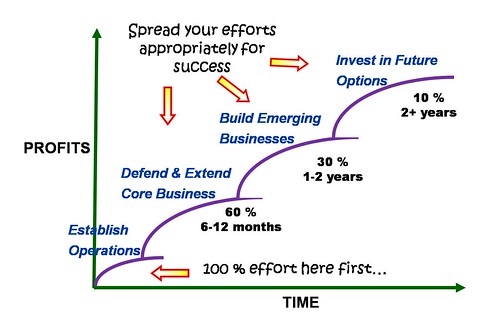
Here is a simple model that can be used to communicate strategy to the organization that is simple but effective for both large and small organizations. Startups especially, can use this to help the team think about something beyond the current month or what will happen after the beta release. If you become a market leader in a new space, you still need to be thinking about the day when your differentiation will be copied or 'commoditized'.


The model works on the simple principal of always thinking ahead. Of course if you are a startup, you initially need to be focused on getting something to market. This required focus and some thinking about market segment targeting. However once you have went to market, there are 3 key curves in which you should be thinking about.

Defend and Extend: This is the hear and now. Many companies spend their entire effort in this curve, only to be surprised by the competition, and forced into a commodity market, which is a losing battle. Spend 60 % of your effort in this curve at any given time. This is your sweet spot and where the business makes the majority of its money. For most companies in the current competitive environment, you should assume this will be a 6-12 month window.

Build Emerging Businesses: Emerging business's are in the 1-2 year time horizon. This is the next big offering that will keep your business on top, once your current cash cow is a commodity. You should be spending about 30% of your efforts in this space, so that when the time is right, these offerings will become your core business.

Invest in Future Options: Future options are in the 2+ year horizon. This is your companies R&D. It is especially important for services businesses, as it is often forgotten. You want about 10% of your effort in this space right now. If you are a startup, this could be as simple as getting the team together for drinks after work and coming up with a few ideas on where your product could get to. The key point is to be thinking about it. As your emerging business becomes your core, so to does your best R&D item become your next emerging business option, and so the cycle continues.

I have found that this is a simple and effective strategy model that can work in large organizations down to a bootstrapping startup. It is a simple effective visual that gets people thinking the right way about sustaining your business, and can be easily communicated.

Saturday, November 11, 2006

Market Segment Targeting

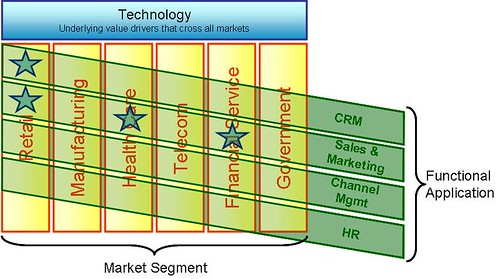
Entrepreneurs (including myself) often suffer from a lack of focus. By nature we tend to be crafting new ideas constantly. Although this is good for keeping your business idea on the cutting edge, it can be detrimental to trying to get something to the right market, and just getting to market at all. With limited time and resources, focus can help. Yesterday I had coffee with one of the judges from the recent start-up speed dating event I participated in, and we walked through a model to help clarify a companies focus and sweet spot. (Thanks to Dave Hallmen for the insightful discussion)

  • Technology(horizontal): This is the value proposition that you are offering. Different customers may more or less need for parts of your value prop, but this is not typically market dependant. If have a focus here, there is typically some underlying IP you are working on, and you should be spending a large portion of your efforts on R&D, since your goal is likely to sell the technology to someone else who will take it to market.
  • Market Segment(vertical): If part of what you are offering, has unique applicability to certain market segments, or you feel that for example your offering has better applicability in certain areas, make a conscious decision to focus your efforts on these areas. Become an expert in those areas of focus, and understanding how to market to these segements is important.
  • Functional Application(diagonal): Decide if your offering has unique application within a specific business function. Look at the intersection of this with the market segments to drive even more focus with limited time and resources.
Looking at your offering based on these 3 dimensions will likely not change your idea or the concept that you are offering, but hopefully it will make you think about focusing in order to better understand what you are building, who you are building it for, and how they will best use it for competitive advantage.