Showing posts with label communities. Show all posts

Thursday, May 24, 2007

Social Software - More Than Technology

Came across a thought provoking essay by Danah Boyd about her take on the significance of Social Software. Its an intriguing read if you are interested in the significance of this concept beyond the tech aspects into more about how it is shaping and changing social behavior.

The article begins by giving an interesting history behind the concepts of social software/social computing and the various definitions. As is often the case, researchers and developers are unhappy with 'new' concepts and come out saying that 'they have always been there', however Danah makes a great point that Social software is about a movement, not simply a category of technologies. The author goes on to say:

It’s about recognizing that the era of e-commerce centered business models is over; we’ve moved on to web software that is all about letting people interact with people and data in a fluid way. It’s about recognizing that the web can be more than a broadcast channel; collections of user-generated content can have value. No matter what, it is indeed about the new but the new has nothing to do with technology; it has to do with attitude.

Danah argues that there are three dramatic changes that have been brought on by Social Software:

1. The way in which technologies are designed - The people behind these technologies are approaching design and deployment in fundamentally different ways. The key design values of the social software movement include:

  • Hack it up and get it out there
  • Learn from your users and evolve the system with them
  • Make your presence known to your users and invite them to provide feedback
  • When you make mistakes, grovel for forgiveness; your human too.
2. The way that participation spreads - Organic growth is at the heart of social software, but organic growth is not just a means of advertising - it is the primary means in which the culture of a site is formed. Values are built into social software, and spread through the networks of people who join.

3. The way people behave - Along with social software came a new way of building context. Unlike in early social technologies (usenet etc) that were about finding people with similar interests the current movement is about people first and topics second. It is far more about connecting to people and watching shared interests emerge through that. Context is no longer defined by the topic but by egocentric collections of people.

A few observations/thoughts that spring to mind:

On technology - I feel that some of this thinking could help bring traditional waterfall development at large organization out of the stone age. I am not talking about mission critical financial applications, but I think in general most 'internal' customers at companies would rather have in-house software on their desk sooner with a few bugs than wait much longer and realize that it wasn't what they really wanted in the first place.

On Participation - How does this aspect affect deployment of social software in business situations and/or B2B environments. I feel that social software can add tremendous value in the business world, but will competitive thinking stand it the way?

On Behavior- How will this movement impact company cultures as organizations begin to tread down the enterprise 2.0 path and experiment with social software. Will it work at all, given that the context for these applications is born in the consumer and social communities.

Tuesday, April 24, 2007

Twitter For Marketing

On a previous post about Twitter, I stated that people would begin to come up with ways to utilize this tool for business purposes, and today I came across a post on the blog Influential Interactive Marketing discussing 4 interesting ways in which twitter could be used for marketing.

  1. Capture the live pulse of an event
  2. Deepen a static experience through live commentary
  3. Facilitate collaborative watching
  4. Add a new dimension to promotions
To me, rethinking the use of Twitter for specific applications such as these will help it move from being a passing fad into something that will provide enjoyment, community and business value.

Sunday, February 18, 2007

Online Existance


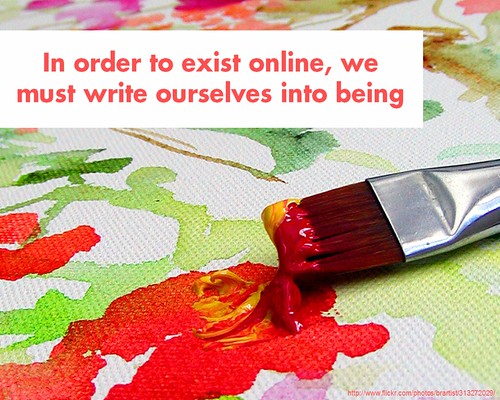
This image from lynetter caught my eye and got me thinking about how this not only applies to individuals but also businesses. Existing online does not mean having a static web page. A tombstone is static content, but it doesn’t mean you will get any interaction. To be part of the new economy you need to exist in some way in the environment that is supporting it. This environment is the internet. It doesn’t really matter what your business is, communication and interaction has always been and will continue to be a cornerstone in any business. It’s not about having a MySpace page or having online chat support into your business – it’s about existing online in a way that makes sense for you and your customers.

Take it even one level higher… watch this amazing video I saw last weekend about how the web is changing our world, and how WE are the machine. (By the way if you like the background music it is a band called Deus and you can download the song for free)


It is one of those things that you will likely need to watch twice for it to start sinking in, and will change the way you view the online world. I have been thinking about it the entire week. People get so wrapped up in web minutia, and they either forget or don’t even see the bigger picture. This presentation offers what I feel is the 100,000 foot view of what is really going on with the web, and it should bring a smile to your face. Often we dwell on the negatives and miss-uses of the internet, but there is always bad with the good, and this will help you see the amazing forward trend that is taking place.

So exist online for yourself, for your business, for your online community, and support the interaction, growth, and sharing of knowledge in this world.


Friday, December 01, 2006

Community Immunity - Will Social Networks Tip?

I recently listed to the audio version of the Tipping Point by Malcolm Gladwell. He has a more recent update to the end of the book where he talks about the concept of immunity and social epidemics.

He introduced the concept of the “fax effect” originally proposed by Kevin Kelly. If you are unfamiliar it goes like this: The first fax machine cost millions of R&D dollars, and retailed for a few thousand dollars, but was relatively useless since there were no other machines to communicate with. Each successive fax machine purchased made all the previous machines more valuable. When you bought a fax machine, you were buying access to the network which is much more valuable than the machine itself. This is referred to as the law of plentitude. Cell companies use a similar concept to market and sell their products and services. The logic of the network is that power and value come from abundance.

Gladwell continues to explain that this is why email is supposed to be so powerful, but is this true? Just like the phone network has grown so large that users have built up ‘immunity’ (answering machines, caller ID, and other filtering mechanisms), so too is this starting to happen with email. When you first got email, and had your first few members of the network, you spent much time and effort crafting well thought out messages. Now we get 1000 (hopefully filtered) spam emails, and often 10’s or hundreds of messages from people. Most email users are now creating shorter responses, being more selective and delayed in response. Gladwell argues that these are all symptoms of immunity, and that large network communication channels have, and will continue to suffer growth tipping points creating immunity, similar to how virus’s spread and eventually die once enough users become immune.

My question is whether this will happen to social networking communities, and I think unfortunately it will. Think about MySpace. Who can really manage a hundreds or thousands of ‘friends’. Once the novelty wears off, when does this network just become like the hundreds of emails you get. Social networks could too reach an immunity tipping point, where they become so large that the very reason that they seemed so attractive, cause its own demise. In a members’ quest to become connected, they are starting to repeat what other networks have already succumbed to. Linkedin is also beginning to show signs of this, with ‘super connectors’ who will link with anyone and everyone. It seems like a great way to grow the network, but this is essentially the beginning of a possible immunity tipping point. Ultimately it comes down to the community members to keep the social network thriving, but not letting it get out of control to a point where community immunity kicks in.