New Blog
Check out my new blog here: blog.kevindonaldson.me
Thanks for stopping by!
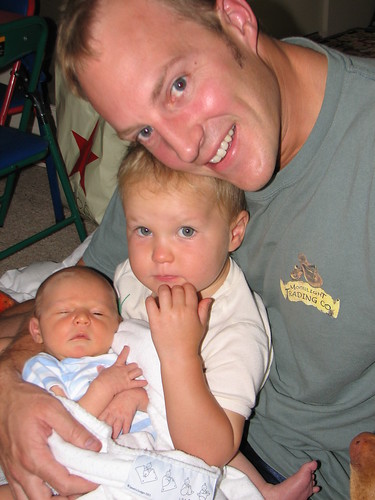 If you are a regular reader, you may have noticed my posts have dropped off recently. This has a strong correlation to the birth of my second son! - Noah Patrick was born on July 9th 2007. (pictured here with me and my other son Hunter) For anyone with kids I am sure that says it all regarding free time, however once things settle a bit, I expect to get back into a more regular routine. Its not just about getting posts out - for me its about training my mind to think, and focus on different ways of doing things. This blog is my tool to do that.
Given that I thought I would share a couple of thoughts on entrepreneurship that came out in some discussions with two friends/mentors of mine on the topic of money recently. (paraphrased)
1. A regular job is about working hard to make money. Being an entrepreneur is about making your money work for you.
2. Entrepreneurship is a game. The goal is to stay challenged and have fun. Money is just a good way to keep score.
Here's to getting a full nights rest sometime soon!
I really like good metaphors. Here is one from Tom Haskins comparing our minds to laptops and the internet, where our conscious mind is the laptop and the 24/7 internet is our unconscious mind.
Most conscious minds rarely access the unconscious mind for solutions, inspirations, and intuitions. They are like laptops that search their hard drive, but do not go online to search the Web. The unconscious mind can guide us into perfect timing so we are in the right place with the right idea in mind to make the right difference. If we ask, we can receive what we need to know, learn what we need to do next and change what we need to upgrade.
Very thought provoking. Many people in business only ever access their own hard drive. Entrepreneurs and innovators strive to get to this level of thinking, but struggle in getting there. Tom provides some ideas in his post on knowing when to access, but to me the hard part is knowing how to form the question to run the correct search? First, I believe it is about finding your creative place. Second, you need to surround yourself with others at work or outside of work who are also trying to get to this level of consciousness or are possibly already there. Third - give it some time to process. The unconscious is vast, and it will take time to draw some conclusions.
I have referred to the Medici Effect in a couple recent posts (here and here), and figured I should post a review/summary of the book. The term Medici comes from a banking family by that name in 15 century Florence Italy. This family and a few others began to sponsor creators from a vast array of fields, which caused people with wildly different skills to come to Florence. Their they found each other, learned from each other and broke down barriers between disciplines and cultures. Together they created a new world based on ideas generated, which became known as the Renaissance.
The author Frans Johansson, does an excellent job looking at intersection innovation and how it can be applied to todays innovators. For me the difference between a good book and a great book is how much it keeps me thinking after I put it down. This was one of those books. I kept a notebook with me as the concepts actually caused me to think about things differently generated new ideas on concepts I have been mulling around in my head.
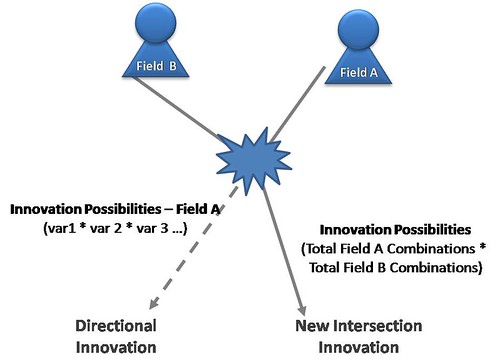
Everything is connected in one way or another. The trick is seeing how these things connect and how to use it. It actually goes against the grain suggesting specialization in a given field is not the best way to produced breakthrough innovation. Field specialization will produce directional innovation. In many fields directional innovation is drying up. All the relevant variables have been combined. We actually have a great chance of achieving ground breaking innovating by not specializing in just a single field of study/work.
If you have two different fields (A, B) and each field has a number of variables to play with your innovation potential in each field is
Innovation potential of A= x1*x2*x3*xn
Innovation potential of B= y1*y2*y3*yn
If you take two different fields of study and combine all the possible variables, your innovation potential has grown dramatically. You now have A*B possible combinations many of which have likely never even been thought about together.
Its not that you can just know a little about many fields - you still need to have some level of depth, but the key is applying concepts from one field to another, and then another etc. How do you do this? Well the book has many suggestions, but one simple way is to begin exposing yourself to different industries. Possibly take a job in a new field, or minimally just studying across different fields and begin to draw parallels with your current specialty areas.
Once change you will see on this blog going forward is that I will begin injecting books into my reading list that will hopefully expose me to other ways of thinking, learning and fields with which I have less knowledge, even though it will likely have nothing to do with my current job or expertise. My current reading list will start to contain titles that don't typically blend with my standard business titles.
In the meantime, if you are looking to find new ways of stretching your thinking, pick this book up and read it. I guarantee it will spawn some creative thinking.
Failure in most companies is a bad word. Some more innovative companies have leaned that failure is part of innovation, but most of what people hear is fail quickly or don't repeat the same mistake which are both good things to keep in mind, but not the whole story. Entrepreneurs are acutely aware of the concept of failure, and it is often equivalent to a badge of honor in the startup community. What else should an innovator (company or person) keep in mind with respect to failures?
Frans Johansson in the Medici Effect says that mistakes and false starts are part of the process for making ideas happen in unknown spaces, and must be factored into the equation in three ways:
Try ideas that fail to find ideas that won't
So how do you create that type of environment?
 There is a series of posts on techdirt (see list at the end of the linked article) that have culminated with a summary article about using the concept of free to grow your business.
The article raise two important points regarding the use of free in your business model. The first is that if done correctly, you can increase your market size greatly. The second is that if you don't, someone else will do it correctly, and your existing business model will be in serious trouble.
The author defines 4 steps that in theory can be applied to any market with respect to the economics of free. (The author admits that some markets might be more challenging than others)
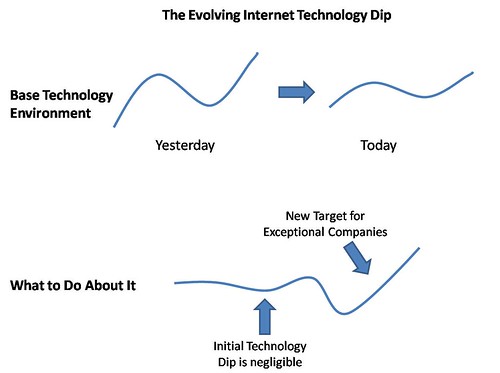
At the intersection of business and technology, people often get very excited or tense, optimistic or worried, challenged (in a good way) or frustrated. Frans Johansson in The Medici Effect talks about intersection innovation - a place where two fields collide and divert along a new innovative path. The collision between business and technology has been a slow moving one over a very long period of time, but companies, are starting to realize, what many or most entrepreneurs already know - the endless number of new paths that can be taken when you start looking at these two areas together instead of separately. We are now at a point where one field can rarely exist for any length of time without the other.
John Hagel has now joined Deloitte & Touche USA LLP and will be heading up a new research center to focus on the business issues created at this intersection.
He poses a number of intriguing questions around this topic of business/technology interesection here with some thought provoking commentary that is worth a look by any reader interested in the topic of this blog.
Foundational
 In 1973 H. J. Rittel and M. M. Webber came up with the idea of the 'Wicked Problem' as it related to social planning. The original definition of a wicked problem included 10 components, however Jeff Conklin later proposed 4 defining elements to wicked problems in 2003:
 This weekend I headed up after work on friday to the Sawtooth Mountains north of where I live with 3 others to climb a great route called the Chockstone couloir on a peak called Grand Mogul. It was a short trip, tiring but extremely satisfying, creating great memories. I get out as often as is feasible, but with a busy job, and a growing family its important to make your free time count.
Recently we have been having a lot of discussions about what our company values are and should be. Values are important no matter how big or small you are. Values create the guardrails by which you work, and make decisions, just like your personal values guide life decisions.
One of the values that many companies speak to and try to have is 'Work Life Balance'. I never really liked this term because of its ambiguity. It seems straight forward, but it isn't. Its the term balance that bothers me. Balance is in the eye of the beholder. What is balance to one person is imbalance to another. Balance implies evenness, but we all know that is never the case with any business in the new economy. Work effort volumes eb and flow like tides of the ocean, and just like weather patterns there are periods of calm as well as hurricanes. In my experience, I find that this term of 'Work Life Balance' is often a buzzword thrown in for appearances, with little thought to what it means, nor how different employees will perceive it. In the end most people are unhappy, because their perceptions of what it means is different from everyone else's.
We wanted something in the same vein as WLB inside our company, battering around terminology such as work life control, and others. We eventually settled on 'Work Life Passion'. Not a huge departure, but subtle enough. The term passion might almost be considered more ambiguous than balance, but to us it says better what the culture of our company is and what we want it to be as it grows. People need to be passionate about their work inside the office and their pursuits outside the office, and strike a balance that makes sense for the company as well as for them. It in no way implies a perfect 50/50 split, and thats ok.
Stowe Boyd often talks about the concept of flow, and your time being a shared space. In the new economy that is often the case. The line between work and home blurs for most, but for most that is better, allowing for a more full life (ie - going to your daughters school play mid day) Also with his definition of flow, time is not constance - it moves faster or slower based on situation. Think about when people talk about being in the zone with sports and time almost slows down as the ball approaches. This flow time is what passion is all about.
Time across work and life is never balanced, but with passion and good use of the time you have allows you to create the balance that is right for you.
Enterprise 2.0 derives from Web 2.0, and refers to social software application that sit behind or are used behind the corporate firewall. Wikipedia has a good entry on the topic, and I just came across this slide deck about Enterprise 2.0 by Scott Gavin. It is very well done and told as a story, that may help you convey the concept in a more understandable way to peers in your organization. Have a look.
 Flipping through some old notes came across this quote. Even with all of our technology, I feel this is more true than ever before. Probably even more so because of technology.
"A business is best considered as a network of conversations"
- Gregory Bateson
Steps to an Ecology of Mind (1972)
A while back I saw a post on Forester about a new article on a topic they called Social Technographics. It peaked my interest and they were offering copies to bloggers, who wanted to review, so I sent in a request. Never heard anything so I went through another source and got the paper anyway, and here is my summary of the key concepts:)
I always find it funny how the think-tanks come up with new terms, register them and then tell everyone how they were the first to come up with the idea. This time its 'Social Technographics' which essentially means describing a population based on their level of participation. Companies are starting to realize that demographics don't mean what they used to especially when it comes to online usage and especially social software. You can no longer equate race, sex or age to social software engagement. Forester suggests that you need to create a social strategy based on how your users map into a set of profiles. They have identified 6 increasing levels of participation. (note - participation levels are not mutually exclusive)
1. Creators: online consumers who publish blogs, maintain web pages, or upload videos at least once a month.
2. Critics: participate by either commenting on blogs, or posting ratings and reviews. Their participation is not near as intense as creators. Critics pick and choose where they offer their thoughts, and often use blogs or other items as a launch pad for their participation.
3. Collectors: save URL's, use social bookmarking, tagging, and RSS. They create meta data that shared with the entire community and add to the self organization of web content.
4. Joiners: one defining behavior - use of social networking sites. Highly likely to engage in other social software activities.
5. Spectators: read blogs, view videos, and listen to podcasts. The audience for the social content created by users in the other groups.
6. Inactives: do not participate in social computing activities. They site this as 52 percent which jives well with this study.
These profiles of course do vary by age. For example teenagers generate more content than any other generation, and joiners are dominated by Gen-Y. However age is not the only way to slice the data. User motivation (entertainment, career, family etc) as well as site features, and brand appeal can all drive different participation profiles.
The key with this is to think about these it terms of your users/customers to define the right strategy with respect to deploying social software. Make sure you deploy what will best fit the participation levels of your audience. Once you understand your audience, Forester continues that you should:
With business audio books an important point needs to really stand out and catch you, because before you know it the reader is on to the next segment. This concept stood out for me the other day while listening to Maverics at Work.
As a leader probably one of the most important things you can do is to walk in stupid every day. You need to keep challenging the organization and yourself to seek out unexpected ideas, outside influences, and new perspectives on old problems. Every day something changes. Look to the inexperience curve. The more you know about something, the more important it is to challenge assumptions and habits that built your success in that area. This will help you think in a new light and drive innovation in your organization.
(By the way - don't confuse leader with manager - they are not related. You don't have to manage people to be a leader in your organization.)
I started looking into details of the Semantic Web about a year ago for a startup idea I was working on with a couple of friends. The concept on SW and the potential of it fascinates me. It is the web where data is stored in ways that machines can understand - not just humans. From Wikipedia:
Humans are capable of using the Web to carry out tasks such as finding the Finnish word for "car", to reserve a library book, or to search for the cheapest DVD and buy it. However, a computer cannot accomplish the same tasks without human direction because web pages are designed to be read by people, not machines. The semantic web is a vision of information that is understandable by computers, so that they can perform more of the tedium involved in finding, sharing and combining information on the web.
From a business perspective this offers massive potential for new waves of development and data analysis in new creative ways. (A good article by Business week on the topic) The interesting thing is that content on the web is already starting to self organize itself through tagging. Tagging doesn't just describe 'what' but many other aspects of the tagged object. This includes human associations that are key to understanding.
For example a take a picture of a cup on flickr which may be tagged with coffee, tea, both etc depending on different perspectives. The association between coffee and cup would not be obvious (especially to a machine!), but you can start to see with a world wide community of users tagging and creating associations, it starts to form the basis for content self-organization and association. This alone, does not create the semantic web, but begins to form the kernels in which to create one.
Tom Haskins refers to this concept in a different light, calling it reflection:
Those of us who search for, link to and tag digital content are practicing reflection...We are externalizing meaning. We are connecting our dots for others to consider how to connect their dots...We call it like we see it and that differs from everyone else. There are many right answers. There are thousands of ways to see it, frame it and use it. We have final say over our idiosyncratic consideration.
The next step beyond creating associations is to begin unearthing unknown or unlikely associations between concepts both inside and outside the walls of the organization. With the startup I was working on last year, part of what we were trying to do was have software help drive innovation, by 'understanding' disparate ideas created by people. By having software understand an idea, and then begin to draw associations between disparate ideas to create new streams of innovation.
Exciting times ahead, and we are all helping the web organize itself and realize the next evolution.
 I am currently listening to Maverics at Work by William Taylor and Polly LaBarre. This morning, just before getting out of the truck, they summed up the first section with 5 questions that I thought would be useful to pass on. They are centered around the concept of thought leadership, and propose that the only true form of market leadership is thought leadership.
5 questions to ask yourself today:
 I have become much more interested in the social, cultural and behavioral impacts and changes deriving from web 2.0 and social software, much more than the technology itself. All those tools and features without any business model are reshaping our culture and the economy.
Stowe Boyd, one of the lead thinkers in this space gave a presentation at Reboot, about his concept on Flow. His presentation is available here. The clip is about 35 minutes long so take some time at your lunch and watch it.
Some of my key takeaways. This isn't by any means a summary of the talk but concepts that jumped out at me...
- First in first out processing works well at a supermarket, but not in an emergency room. We are now living in a world that is much more like an emergency room.
- We are actually moving to more of a pre-industrial/agricultural consciousness. More like that of a tribe.
- Today your time is a shared space, which conflicts with current business norms. Is what you are doing of greater benefit to you (or your boss) or does it benefit the tribe?
- The buddy list is the center of the universe. I am made greater by the sum of my connections & so are my connections.
- Productivity is second to connectivity. Network productivity trumps personal productivity
This type of thinking goes well beyond how, and what tool you should let in or look to utilize in your business to satisfy your customers, employees or give a boost to your search results or marketing campaign. Its about understanding how cultural norms are shifting and how you as a business will need to react. I like Stowe concept of the tribe, and although he used it in the context of your social network, I feel like this concept can be brought into an organizations, and supported by the right tools, will help support the productivity of the organizational tribe. The majority of companies are no longer living in a supermarket world (even if their business is supermarkets!). Business is now an emergency room.
Hierarchies are tools that can used to categorize information into groups with logical 'parent-child' relationships. You see them everywhere, but the issue with them is that they are only one person's or one companies opinion of how the world looks. Companies use them extensively to describe their organizational structure, their process models, their product inventories, and this works great when everyone in the organization can be trained to fall into line and talk the same language.
However your customer doesn't always think in the same way as you. Their hierarchy may be different or most likely they don't think about a hiearchy at all! Second, not only are their new categories popping up all the time, but the lines are blurring between many categories. What once fell neatly into a well defined bucket, can produce hours of debate with no right answer.
The concept of folksonomies has become popular with the rise of Web 2.0. Folksonomies are user generated taxonomies or structured use to categorize content typically with the use of tags and tagging. Most people are familiar with tagging, but companies don't often see how this could or should be applied within an organization. However its not an all or northing decision. For example, it would be chaotic to organize your inventory internally through employee or customer created folksonomies (for the purpose of warehousing, ordering etc), but at the same time, why force your customers to try and figure our your archaic structure when they are trying to find a product to purchase? Yes search can help but customer driven folksonomies will help even more AND if tapped can also help search.
The thing is that most people in business today grew up in a world of parent child hierarchies. It has been ingrained in the way we think. Putting things into strict classifications helped us feel in control, but with the pace of change today, structures are quickly outdated and become very painful to re-organize. In our business we constantly fight with trying to classify advertising mediums, (ways in which you could advertise a product). It use to be simple - print, radio, television, direct mail and a few others captures almost everything. The fragmentation in this space is mind boggling now. How do you accurately categorize a blue tooth text messaging cell phone campaign? Or what about a direct mail campain via email. Is it an online offering or direct mail? Well its both but more importantly, it depends on who's doing the searching.
Even stretch your mind to think about internal classification structures. Since I have a background in process engineering, I know that people love to define and map out strict process hierarchies and 'teach' the rest of the organization how the business operates. But could processes be organized into employee created folksonomies to some degree? Process ownership and accountability is still required so its not about letting everyone decide separately how the organization runs itself, but the issue comes when people are trying to 'find' the details of a given process. (maybe for a new software application implementation) Do I find the 'employee onboarding process' under HR, under operations, under IT? (well it actually touches all three and more). Accountabilities aside, if tagging was was available and used, there would probably be a lot of time and argument saved by not having to create a hierarchy that meets everyones view of the world. And most importantly, the person who really needs the information, can find it.
The key point with this is to think about who your customers are (whether internal or external) and what they are trying to do with your information. The easier they can find, store and categorize in their terms, the more likely they will use your information assets in the future. How you categorize and use the data is completely different than how they see or want to use the data. Don't make it your customers problem to understand your structure.
A while ago, I posted about re-thinking the newspaper industry. Here are a couple of ideas I had around innovating in that space. I by no means have any background in this industry, but here goes. In my language customer is defined as a person who gathers utility from reading the contents of a newspaper.
Product Innovation: Allow readers to customize their content. This is not a new concept online. Personalized home pages, email alerts, RSS are all commonplace across the web, and if not already should be integrated into the online channel for the newspaper. This will not only help you better understand what your readers are interested, and allow for better targeted advertising, but will also make them better able to navigate the reams of content available.
Second, in the same vein - appreciate the fact that many of your users don't have an interest in online reading, however that doesn't mean that you should be able to provide them tailored content. Printing innovation is evolving rapidly. Why not allow a subscriber to tell you what they are interested in and have a customer newspaper printed for them based on these interests? Then urge them to go online and rate the content that was delivered so that future papers can further be tailored to their interests. (similar to what some companies are doing to tailor music streaming)
Beyond that I see digital newsstands that would allow a user to select from a menu, and have a custom paper printed off immediately on authentic newsprint (like a soda machine that spits out a newspaper). Plus advertising and print layout would be defined on the fly by software. Further - give people a plastic 'remember me' card, so that they can use with other electronic newsstands, of which get updated every time they make a change (similar to an ATM). Once this is attained - next step is partnering with other news organizations to share/combine content. (Give me the wall street journal combined with Boise local business in one paper!)
Business Model Innovation: Why not create a model where the price of the paper to the end customer varies based on how much advertising they are willing to accept. The more ads, the cheaper the paper becomes. It has been shown that people are willing to pay for advertising free niche content. Think pay-per-view or Sirius. This could initially be packages with varying levels of advertising along with various skews towards types of content (local, sports, business, etc) The content selection would then of course help associate related advertising.
Next combine the two ideas. Allow for infinite tailoring of content to what users need combined with business models that allow pricing to vary by customers interest or lack thereof for advertising, and have any advertising sent be targeted. Meet the long tail needs of your readership.
These may seem unrealistic (or maybe not), but in the end its about thinking on the edges. Most of what I talk about here requires technology and online interactions with consumers, but it doesn't rely solely on the online medium for content delivery.
Now when we get to a point where e-paper is almost as flexible as real paper (we are not that far off), that opens up entirely new opportunities.
 Where and when do you do your best creative thinking? Have you ever thought about it? What type of surroundings put your mind in an open state? A friend once told me that he even had creative 'seasons'. He found that spring was his most creative time of the year. Ben McConnell gets bursts of creativity in the shower, and he attributes it to higher ceilings. For quite some time while I traveled for work, my idea flow was very high on airplanes. Now of course if I am stuck in a middle seat near the back this isn't going to be the case, but more often then not, I get off an airplane with a lot of interesting notes scribbled down based on whatever I happened to be reading about. In this case it can't be the high ceilings, but maybe its looking out the windows? I have even written poetry in airplanes at different points, and believe me I am no poet:)
I do believe that the concept of bigger spaces creating better idea flow has merit. The feeling of openness and freedom somehow transfers to thought patterns, making them less constrained. The next logical question is how to create work environments that will allow the idea flow to increase. Since this will be different to different people, much of this will be tapping into your own sensations of creativity and working with it yourself. In contrast with most places I have worked at in the past, my current office environment is very creative for me. It does have high ceilings buts its more a feeling than any ability to articulate why it works. In addition to the ceilings, I think it's the traditional building materials (exposed brick and wood, and steel) that are part of it in addition to the open atmosphere. In contrast, I find new age materials do not stimulate idea flow, even when working in space age pod like set ups I have seen companies try and pull off. Everything seems too manufactured, and it doesn't matter how high the ceiling is.
Additionally, I need some connection to the outdoors. An ability to look out a window, and connect with the biggest open space of all. This of course isn't always feasible but not all your creative thinking needs to be in a designated work space between 8 & 5. Experiment and find different creative places for you. My front porch (view shown in picture) for instance has become a good idea flow space for me (at least when the weather is good). Open air, birds, wind chimes - not sure what it is, but its not really about the how. If it works, be aware of it, and use it.
What works for you?
 Kevin Donaldson -- Boise, Idaho
Summary
An Entrepreneur trying to improve his ability to think on the edges.
This is no longer an active blog, but I leave the content up to add to the overall internet knowledge pool! However you can Follow me on Twitter! and check out my new blog here!

